


Acrostic Crossword Puzzles
4.3169.00 Reviews
App Specs
- Version
- 5.2.4
- Updated On
- License
- $4.99
- Downloads
- 10,000+
- Developer
- Egghead Games LLC
- Categories
- Word
- Platform
- Android, iOS
Screenshots
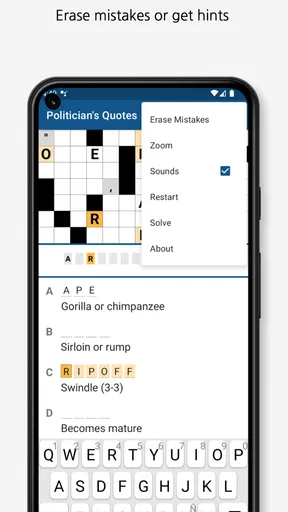
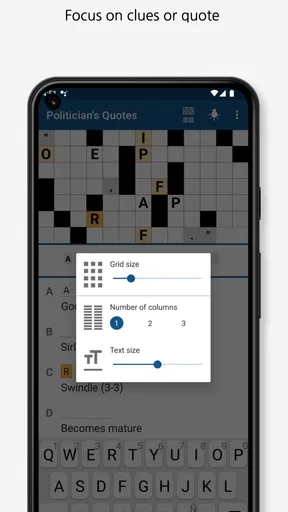
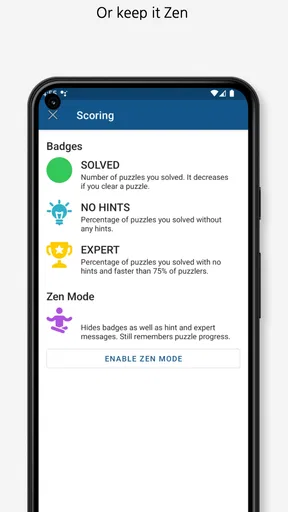
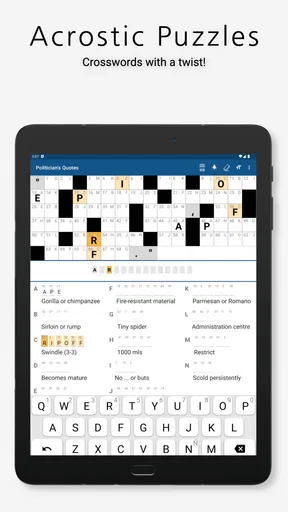
 Analysis by AppCompare
Acrostic Crossword Puzzles is a word game I would recommend to anyone who enjoys the quiet satisfaction of solving clues but wants a little more purpose than filling a standard crossword grid. Its central idea is simple: solve a set of crossword-style clues, then use the completed answers to uncover a quotation. That extra layer changes the rhythm completely. I am not only searching for individual words; I am also checking whether those words work together as part of a larger message.
That makes the game feel closer to a conversation between a crossword and a cryptogram than to either one on its own. The clues test vocabulary, while the hidden quotation gives me a reason to keep going when one stubborn answer refuses to appear. Developed by Egghead Games LLC, it is a paid word game for Everyone, with a 4.3 average from around 467 ratings and more than 10K installs. Those figures suggest a smaller, focused audience rather than a huge casual-game crowd, which fits my experience: this is a deliberate puzzle game for people who like thinking time.
How the puzzle loop feels in practice
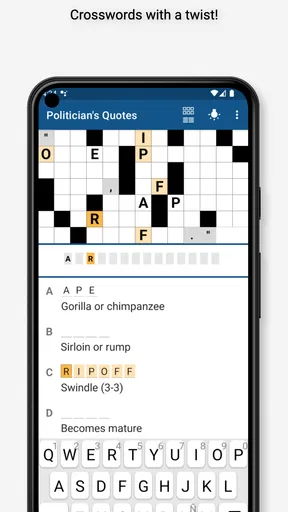
A typical session begins with clues that look familiar to crossword players. I work through the answers I know, use crossing letters to narrow down uncertain ones, and gradually build enough of the puzzle to see patterns. The hidden quotation adds a second source of information. If the emerging phrase starts to make grammatical or thematic sense, it can help me reconsider an answer that seemed plausible but does not fit the larger message.
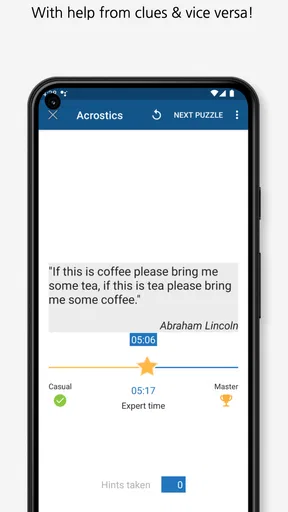
This two-way solving process is the game’s strongest design choice. In an ordinary crossword, a wrong answer can remain hidden behind a few crossings. Here, the quotation acts like an additional check. It does not make every clue easy, but it gives the puzzle a broader internal logic. I find that especially satisfying when I am stuck between two possible words: the letters from the surrounding entries and the developing quotation can eventually point toward the better choice.
The result is a slower, more reflective form of word play. I do not approach it like a fast arcade game, and I would not want to. The appeal is in making small discoveries, correcting assumptions, and watching a sentence take shape. It is well suited to a short break with a cup of coffee, but it also works as a longer evening activity when I want something mentally active without the pressure of a timer or a competitive leaderboard.
One useful habit is to avoid attacking the clues in strict order. I start with the answers that have an obvious definition or a distinctive length, then use those letters to open up the less familiar entries. Once a few parts of the quotation become visible, I switch between clue solving and phrase recognition instead of forcing myself to finish one area first. That workflow makes the game feel more flexible and reduces the frustration of staring at a single clue for too long.
Why the quotation layer matters
The quotation is not just a decorative reward at the end. It changes how I evaluate every answer. A word can appear to fit its clue and still feel wrong once the hidden sentence begins to emerge. This creates a useful form of self-correction without turning the game into a simple answer-reveal exercise.
Worth Reading Before You Choose

EA SPORTS FC Mobile 26 Is a Bigger Football Game, but It Takes Time

Flipboard Shows What News Apps Must Do Beyond the Feed

Switching to Android Auto Means Rethinking Your Driving Routine

Google Calendar Makes a Crowded Week Easier to Manage

Ludo King Makes the Most of the Minutes Between Plans

Baby Panda World Brings Quick Play to Modern Phones, but Its Game Library Feels Busy
That structure also gives completed puzzles a stronger sense of closure than many word games. Finishing a crossword can be satisfying because the grid is full; here, I also get the moment when the final phrase becomes readable. The destination gives the individual clues more meaning, even though the game remains fundamentally about vocabulary and deduction.
There is a small educational benefit as well. I occasionally meet an unfamiliar word while solving, but the surrounding letters and quotation context make it easier to remember than an isolated dictionary definition would. I would not describe the game as a formal language-learning tool, since its purpose is entertainment, yet it rewards attention to spelling, synonyms, word length, and context. Players who enjoy expanding their vocabulary may get more from it than someone who only wants rapid, familiar answers.
Where it fits among word-game alternatives
Compared with a conventional crossword app, this game offers more guidance once the hidden quotation starts to appear, but it also asks me to think about the puzzle at two levels. A standard crossword may feel better when I want a broad grid with varied clue interactions. This format feels better when I enjoy a clear thematic payoff and like using language context as part of the solving process.
It is also different from a pure cryptogram. Cryptograms usually begin with a coded sentence and ask me to identify letter substitutions. Here, the clues provide the main work, and the quotation emerges from the answers. That makes the experience more approachable for crossword fans who find traditional cryptograms too abstract, while still offering the pleasure of decoding a message.
Against quick daily word games, the trade-off is obvious. I get more depth and a more substantial solving arc, but I do not get the instant, highly repeatable loop of guessing a short word in a minute or two. If my goal is a tiny routine that I can complete while waiting in line, a simpler daily word game may be a better match. If I want a puzzle that can hold my attention beyond a single guess, this one has the advantage.
Small strategies that improve the experience
My first practical tip is to treat the quotation as a hypothesis, not as an answer key. When a phrase seems obvious, it is tempting to force every remaining entry to support it. That can create a chain of mistakes. I use the emerging sentence to generate possibilities, then return to the actual clue and crossing letters before committing. The quotation is most useful as a filter, not as permission to ignore the clue.
Second, I leave genuinely uncertain entries alone rather than filling them with a guess just to make the board look complete. A tentative answer can distort several crossings and make the hidden phrase harder to read. Solving the surrounding clues first often supplies enough evidence to return with confidence. This is particularly helpful when a clue could reasonably suggest more than one synonym.
Third, I read the completed quotation as a final quality check. If the sentence sounds awkward, incomplete, or inconsistent with the visible letters, I look for a questionable answer instead of assuming the quotation itself is wrong. That habit turns the final stage into another reasoning step rather than a passive reveal.
These techniques are not complicated, but they expose what makes the game distinctive. Its best moments come from moving back and forth between local clues and the global sentence. Players who enjoy that kind of layered deduction will likely find the format more rewarding than a collection of unrelated word challenges.
The main limitation: the format is not for every mood
The same structure that gives the game its identity can also create friction. When I cannot solve a key clue, the quotation may remain too incomplete to help, leaving me with two connected problems instead of one. A regular crossword can sometimes be rescued by moving to another section of the grid; here, a difficult answer may feel more central because it blocks progress toward the hidden message.
The experience also depends heavily on comfort with written clues. Players who prefer visual puzzles, rapid reactions, or word games built around experimentation may find the pace too restrained. There is no appeal here for someone looking for animation-heavy entertainment or a competitive social challenge. The pleasure is private and cerebral, and that narrow focus is both its strength and its boundary.
The paid entry point is another consideration. The game costs $4.99, and in-app purchases range from $3.99 to $8.99 per item. I see the purchase model as something to examine before starting, especially if I prefer a single upfront payment with no additional spending. The price may feel reasonable to a dedicated crossword player who expects many thoughtful sessions, but a casual player who only occasionally opens word games may be better served by trying a free alternative first.
Its age is worth keeping in mind too. The game was released on Mar 18, 2013, and the current version is 5.2.4. That does not undermine the core puzzle concept, which remains easy to understand, but it helps explain why the experience feels centered on solving rather than on modern presentation trends. I would choose it for the puzzle mechanics, not for a flashy interface or a constantly changing live-service structure.
Who should spend time with it
I think it is a particularly good fit for crossword fans who enjoy quotations, word associations, and the feeling of gradually revealing a complete thought. It also suits people who like solo games that can be paused without losing the thread. A commuter could work through a few clues, put the phone away, and return later with the partially uncovered sentence still acting as a useful memory cue.
It can work well for two people sharing a screen informally, too. One person may be stronger at general knowledge while the other notices language patterns in the quotation. The game does not need to be competitive to become conversational; discussing whether a clue points to one synonym or another is enough to make a session feel collaborative.
I would be more cautious about recommending it to children who are still developing reading confidence, even though the content rating is Everyone. The rating indicates broad suitability, but the actual enjoyment will depend on vocabulary and patience. A child who already likes word clues may find it rewarding, while a younger player expecting a quick, highly visual game may lose interest.
I would also steer away players who dislike quotations or who want unlimited novelty from a procedural puzzle system. The hidden-message format is the reason to play, but it can feel repetitive if that particular payoff does not appeal. Likewise, people seeking a competitive score chase, social matchmaking, or a fast daily ritual should look toward another kind of word game rather than expecting this one to change character.
Practical expectations before installing
On Android, the listed minimum operating-system requirement is version 6.0. That makes compatibility straightforward for many older devices, but I would still check the phone or tablet before paying, especially if it has been kept on an unusually old system. The game is classified as a word title and carries an Everyone content rating, so its appeal comes from puzzle structure rather than mature themes or action.
The developer is Egghead Games LLC, and the modest install count gives the product a more independent feel than the biggest word-game brands. I do not see that as a problem by itself. In fact, the focused design benefits from not trying to imitate a broad entertainment platform. Still, players who value a large online community, frequent social events, or extensive public competition may find a more mainstream crossword service more suitable.
Before buying, I would ask myself one simple question: do I enjoy solving clues for their own sake, or do I mainly want a quick word distraction? If the answer is the former, the hidden quotation provides a meaningful extra goal. If it is the latter, the layered format may feel like unnecessary work. That distinction is more important than the rating or install figure because it determines whether the game’s deliberate pace feels relaxing or slow.
For me, the best everyday scenario is an uninterrupted ten-to-twenty-minute window when I want to focus on something small but substantial. I can begin with easy clues, make progress without needing a network of other players, and stop at a natural point once the quotation starts to emerge. It is less suitable for distracted multitasking, because careless guesses can contaminate the crossings and make the later deduction harder.
My verdict
Acrostic Crossword Puzzles succeeds because it gives ordinary clue solving a second layer of meaning. The hidden quotation is not merely a finishing flourish; it changes the way I test answers, recover from difficult clues, and judge whether the completed puzzle feels coherent. That makes the game more thoughtful than a basic crossword collection while keeping the rules approachable.
Its limitations are clear. The pace is calm, the format can become demanding when one clue blocks the quotation, and the purchase options deserve attention from anyone who prefers a completely simple payment model. It is also not a substitute for a competitive daily word game or a visually rich casual title. Those are fair trade-offs, but they mean the recommendation depends strongly on the player.
My final recommendation is for patient word-game players who want deduction with a satisfying literary payoff. If that sounds like you, the $4.99 price can make sense when you expect to return for focused solving sessions rather than a one-minute distraction. If you prefer speed, social competition, or a familiar grid without an added message to decode, another crossword or daily word alternative will probably serve you better. For the right audience, though, this is a charmingly focused puzzle: every answer matters twice, first as a clue solution and then as part of something larger.
Pros
- Combines crossword clues with acrostic solving for varied gameplay.
- Large letters and clear layouts make puzzles comfortable to read.
- Helpful hints reduce frustration when a clue proves difficult.
- Works well for short sessions or longer relaxing play.
- Puzzle progress is easy to follow across partially completed grids.
Cons
- Some puzzles may feel repetitive after extended play.
- Advanced players may find easier grids lacking in challenge.
- Hints can reduce the satisfaction of solving clues independently.
- Small interface controls may be awkward on compact phone screens.
- New puzzle availability may depend on updates or in-app purchases.
FAQs for Acrostic Crossword Puzzles
What is Acrostic Crossword Puzzles?
Acrostic Crossword Puzzles is a word game that combines crossword-style clues with an acrostic letter puzzle. You solve a series of definitions and use the answers to reveal a quotation, phrase, or hidden message. The game is designed for players who enjoy vocabulary challenges, careful deduction, and a more relaxed alternative to fast-paced arcade games.
How do you play Acrostic Crossword Puzzles?
Each puzzle presents clues that must be answered with words of specific lengths. After entering the correct answers, selected letters are transferred into a separate grid, gradually uncovering a quotation or phrase. The main challenge is using the revealed letters to confirm uncertain answers while also using completed clue answers to solve the hidden message.
Is Acrostic Crossword Puzzles suitable for beginners?
Yes, the game is generally accessible to beginners, especially for players familiar with crossword puzzles or word games. Early puzzles usually help you understand the answer-and-quotation format before introducing more difficult vocabulary and less obvious clues. However, some puzzles can still be challenging, so patience and a willingness to use hints may be helpful.
Does Acrostic Crossword Puzzles offer hints or assistance?
Most versions of Acrostic Crossword Puzzles include some form of assistance, such as revealing a letter, filling in an answer, or helping identify an incorrect entry. The exact hint system can vary by version and may be limited by an in-game currency, advertisements, or optional purchases. It is worth checking these details before relying heavily on hints.
Is Acrostic Crossword Puzzles free to download and play?
Acrostic Crossword Puzzles is commonly available as a free download, but the overall experience may include advertisements, optional in-app purchases, or paid content depending on the edition and platform. The basic puzzles can often be played without paying, while purchases may provide extra hints, remove ads, or unlock additional puzzle collections.


